
Research Highlights
Modelling Breast Density with Synthetic Hydrogel Reveals New Pathway for Cancer Prevention
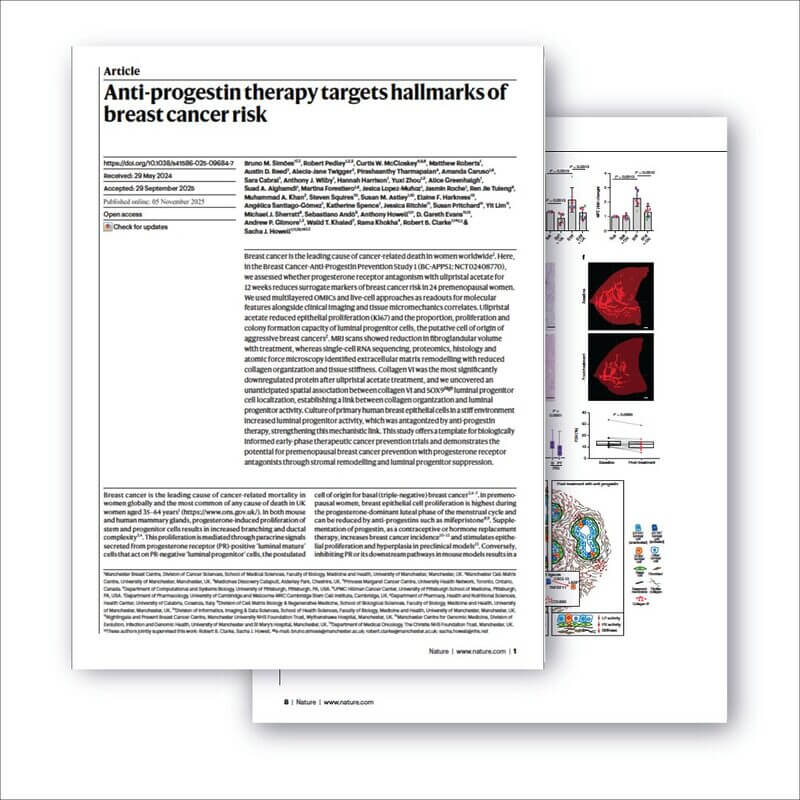
 VitroGel® enables precise modelling of breast tissue stiffness to study how anti-progestin therapy suppresses cancer cells.
Category:
Organoid
Subategory:
Tissue Fragment/PDX/ Ex vivo
Cell Types:
Human Breast Epithelial Cells
Hydrogel:
VitroGel® COL (TWG009)
Institutions:
Division of Cancer Sciences, Breast Biology Group, The University of Manchester
Team:
Bruno M. Simões, Robert Pedley, Curtis W. McCloskey, Matthew Roberts, Austin D. Reed, Alecia-Jane Twigger, Pirashaanthy Tharmapalan, Amanda Caruso, Sara Cabral, Anthony J. Wilby, Hannah Harrison, Yuxi Zhou, Alice Greenhalgh, Suad A. Alghamdi, Martina Forestiero, Jesica Lopez-Muñoz, Jasmin Roche, Ren Jie Tuieng, Muhammad A. Khan, Steven Squires, Susan M. Astley, Elaine F. Harkness, Angélica Santiago-Gómez, Katherine Spence, Jessica Ritchie, Susan Pritchard, Yit Lim, Michael J. Sherratt, Sebastiano Andò, Anthony Howell, D. Gareth Evans, Andrew P. Gilmore, Walid T. Khaled, Rama Khokha, Robert B. Clarke, Sacha J. Howell.
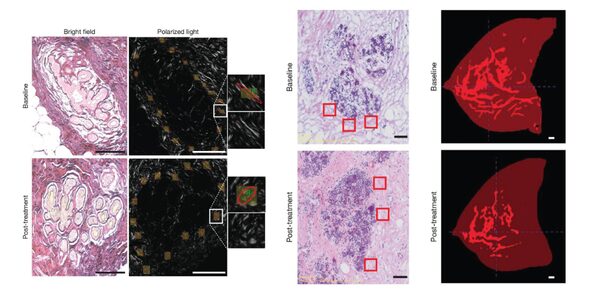
 Breast cancer remains the leading cause of cancer-related death in women worldwide. A key risk factor in breast cancer development is partly attributed to high mammographic density, which is not only visible on mammograms but is also driven by a stiffer extracellular matrix (ECM) rich in collagen. This stiff microenvironment can promote the growth of luminal progenitor cells, the very cells thought to give rise to aggressive breast cancers. Until now, studying how tissue stiffness influences cancer risk in human breast tissue has been challenging due to the lack of in vitro models that accurately mimic the mechanical properties of the breast. With VitroGel®, a xeno-free and tunable hydrogel system, researchers can examine how the ECM and different mechanical strengths present within the breast tissue influence cellular responses to anti-hormone therapies.
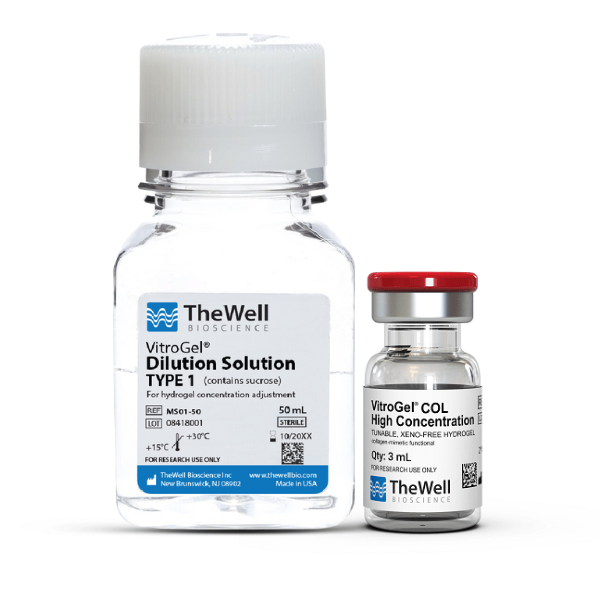
In this study, researchers used VitroGel® COL High Concentration, a collagen-mimetic hydrogel, to create 3D breast tissue models with tunable stiffness. They cultured breast organoids from women at high-risk of developing breast cancer in “soft” (600–900 Pa) and “stiff” (1,800–3,000 Pa) hydrogel conditions that mimic healthy and high-density breast environments, respectively. The team discovered that stiffer gels increased the activity and expression of markers of luminal progenitor cells (such as SOX9 and KIT) and enhanced progesterone signalling. Importantly, treatment with anti-progestin drugs (ulipristal acetate and onapristone) in the stiff hydrogel environment reversed this effect, suppressing progenitor activity and blocking stiffness-driven cancer pathways. VitroGel®’s reproducible and physiologically relevant stiffness settings were essential for uncovering how mechanical cues and hormone signalling interact to elevate cancer risk.
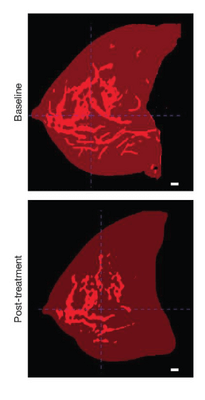
Simões et al. further demonstrated that anti-progestin therapy can remodel the breast microenvironment, reducing tissue stiffness and the number of cancer-susceptible luminal progenitor cells. VitroGel® COL High Concentration (Cat No. TWG009) was instrumental in this study by providing a controllable, human-relevant platform for simulating tissue mechanics and testing preventive therapies. Beyond this research, VitroGel®’s ability to model matrix stiffness offers a powerful tool for future cancer prevention studies, drug screening, and personalized risk assessment.
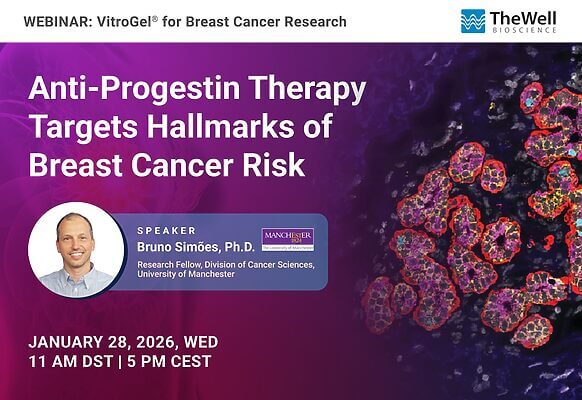
Discover how VitroGel® can support your cell culture research
Explore our updated resources for a concise overview of VitroGel®’s key features and application areas.
Comparison of VitroGel® vs. Animal-based ECM
Discover the 20+ advantages of VitroGel® over animal-based ECM with this comprehensive comparison on key features, operation, application, and storage conditions.
Learn More
What is VitroGel® | Overview Video
Learn why VitroGel® is the leading animal-free hydrogel for 3D cell culture.
Learn More
VitroGel® for Breast Cancer Models
Learn about the multiple ways to study 3D breast cancer models with VitroGel®.
Learn More