
News
Tracking Progress: Key Milestones Toward Animal-Free Research with NAMs
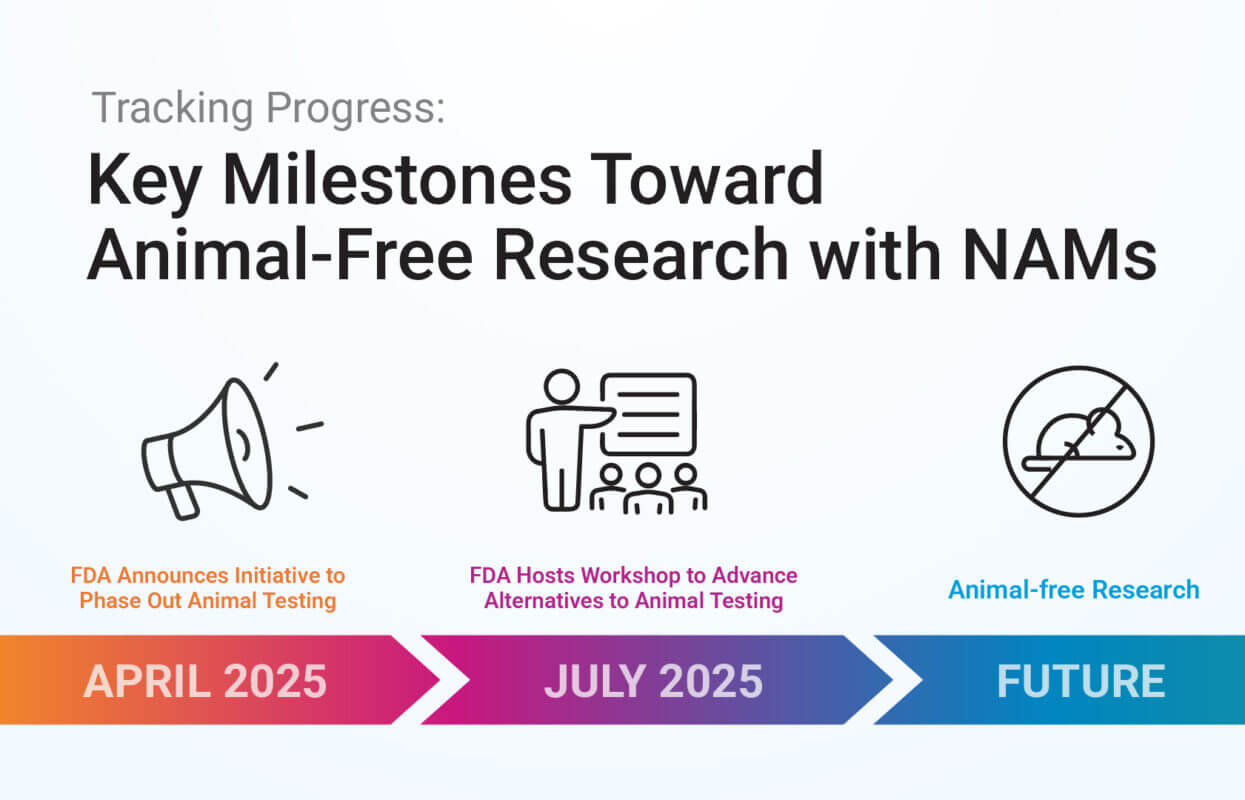
As the pace of scientific innovation increases, there is a growing demand for research models that are not only more ethical, but also more predictive of human biology. In the United States, two major agencies—the FDA and NIH—are actively driving the transition away from animal testing through the advancement of New Approach Methodologies (NAMs). Through regulatory updates and strategic funding shifts, they are reshaping the landscape of biomedical research and drug development with a strong emphasis on human-relevant science.
April 20, 2026 | FDA Achieves First Year Goals in Reducing Animal Testing in Drug Development
The FDA announced that it has successfully met its first-year milestones in its effort to reduce reliance on animal testing in drug development. This initiative is part of a broader plan to modernize how new therapies are evaluated.
A key focus of the program is the adoption of New Approach Methodologies (NAMs)—such as human cell–based models, organoids, and computational tools—which can provide more human-relevant data compared to traditional animal studies.
Over the past year, the FDA has:
- Published draft recommendations to help phase down or potentially remove the use of nonhuman primates in monoclonal antibody research
- Revised guidance to encourage alternatives to horseshoe crab–based endotoxin testing, with the potential to protect over a million animals each year.
- Taking steps to limit or waive animal testing requirements when drugs already have strong human safety data from use in other countries.
- Introduced draft guidance supporting a weight-of-evidence framework, making it easier for developers to use NAMs such as lab-based assays and computational models.
- Approved the first AI-powered tool for drug development, signaling increased confidence in advanced computational models for regulatory use.
- Rolled out a searchable resource outlining where non-animal methods are accepted, while also working closely with global regulators to align approaches better.
These efforts aim to make drug development more efficient and predictive, while also reducing costs and ethical concerns associated with animal testing.
March 18, 2026 | NIH invests $150 million to advance human-based research and reduce animal model use.
The National Institutes of Health (NIH) is investing $150 million to advance human-based research methods as alternatives to animal models. By promoting technologies like organoids, organ-on-a-chip systems, and computational models, the initiative aims to improve research accuracy, efficiency, and ethics. This effort is supported by a new office, Office of Research Innovation, Validation, and Application (ORIVA), which will help validate and scale these approaches for broader adoption.
Key Points:
- $150 million investment to support human-based research technologies
- Focus on New Approach Methodologies (NAMs):
- Organoids and 3D tissue models
- Organ-on-a-chip systems
- Computational and AI-based models
- Goal to reduce reliance on animal testing.
- Addresses the poor translation of animal models to human biology
- Establishment of ORIVA to validate and implement new methods
- Future funding to encourage or prioritize human-relevant approaches
- Expected outcomes:
- More predictive and clinically relevant data
- Faster and more efficient drug development
- Improved ethical standards in research
January 22, 2026 | EPA Administrator Lee Zeldin announces the agency is recommitting to its goal of eliminating mammalian animal testing by 2035.
The Environmental Protection Agency (EPA) has formally recommitted to a plan to phase out all mammalian animal testing by the year 2035. This initiative reinstates specific deadlines for ending the use of vertebrate animals—such as rabbits, mice, rats, and dogs—in toxicity evaluations for chemicals and pesticides.
The key components of this plan include:
- Development of Alternative Methods: The agency is prioritizing the use of “New Approach Methodologies” (NAMs). These include high-quality, non-animal scientific methods for conducting safety evaluations, such as those recently used for cancer assessments of certain chemicals in paints and cosmetics.
- Regulatory Framework Updates: The agency is reviewing its guidance and federal regulations to allow greater flexibility in meeting data requirements, including issuing waivers when non-animal testing is available.
- Collaboration and Adoption: The EPA plans to work with other government agencies, researchers, and advocacy groups to validate alternative methods and facilitate the adoption of new technologies. It also aims to transition animals currently used in labs into adoption programs.
- Scientific Objectives: The goal is to move toward testing methods that are more relevant to human biology while maintaining rigorous safety standards for human health and the environment.
Click to view 2025 Progress Towards NAMs
November 11, 2025 | UK Unveils Roadmap for Alternative Methods
The UK has introduced a new strategy aimed at speeding up the shift away from animal testing by promoting modern, human-focused research technologies. The plan sets clear goals for reducing animal use in specific types of testing and increases investment in alternatives such as organ-on-a-chip models, AI-based analysis tools, and advanced lab-grown tissues. With coordinated support from government, industry, and scientific organizations, this roadmap represents a major step toward more ethical, efficient, and accurate testing methods.
- The government has pledged to scale back and eventually end animal testing as modern alternative methods are introduced.
- Animal welfare and life sciences groups have described the new strategy as “ambitious” and “timely.”
- A £75 million funding package will support the development of advanced testing technologies for life-saving products and help clarify regulatory processes for researchers. New technologies include:
-
Organ-on-a-chip: small devices that use human cells to act like real human organs.
-
AI tools: use large datasets to predict whether new medicines are safe and effective.
-
3D-bioprinted tissues: lab-made human tissues (like skin or liver) that can be used to study biology and test for toxicity.
-
- The strategy was created jointly with industry, scientific partners, and animal welfare organisations, fulfilling a key commitment in the government’s manifesto.
September 25, 2025 | NIH Establishes SOM Center
The NIH is establishing the Standardized Organoid Modeling (SOM) Center, the nation’s first dedicated facility for organoid development, to reduce reliance on animal models and enhance reproducibility in organoid research.
Key points:
- The center has been awarded $87 million in contracts over the next three years and will be housed at the Frederick National Laboratory for Cancer Research.
- Its mission is to develop standardized, reproducible organoid-based protocols (new approach methodologies, or NAMs) using advanced tools like AI, robotics, and diverse human cell sources.
- The center will support researchers across academia, industry, and government, offering open access to protocols, data, and organoid resources.
- The initial focus will be on organoid models for the liver, lung, heart, and intestine, with future expansion to additional organs and disease models.
- SOM will collaborate with regulatory bodies (e.g., FDA) to ensure the models meet preclinical testing standards, thereby accelerating therapeutic development and safety evaluation.
July 7, 2025 | FDA-NIH Workshop on Reducing Animal Testing
The FDA hosted a hybrid workshop on July 7, 2025, to focus on reducing animal testing in research and regulatory science. The agenda centered on the implementation of novel methodologies and strategies aimed at minimizing reliance on animal models. Speakers from the FDA, the National Institutes of Health (NIH), and international regulatory agencies shared insights on the progress, challenges, and opportunities involved in adopting New Approach Methodologies (NAMs)—including human tissue-based models, organoids, and 3D culture systems. During the workshop, the NIH announced a significant policy shift: it will no longer issue new funding opportunities that are limited to animal models of human disease. Moving forward, all NIH funding announcements must include explicit consideration of NAMs—a decisive step toward promoting more ethical, scientifically advanced, and human-specific research practices. This reinforces support for a range of validated, non-animal models such as:
- Organ-on-a-chip systems
- Organoids, spheroids, and co-culture models
- Advanced 3D cell culture technologies
April 10, 2025 | FDA Introduces NAMs Initiative
The U.S. Food and Drug Administration (FDA) recently announced a groundbreaking initiative to phase out the animal testing requirement for monoclonal antibodies and other drugs. This marks a significant milestone in advancing preclinical research toward the gradual elimination of animal use in safety testing. As outlined in the agency’s roadmap, the FDA is embracing New Approach Methodologies (NAMs)—innovative, non-animal technologies such as organoids, microphysiological systems, and AI-driven models. These tools offer more ethical, scalable, and human-relevant alternatives to traditional animal testing.
TheWell Bioscience Commitment
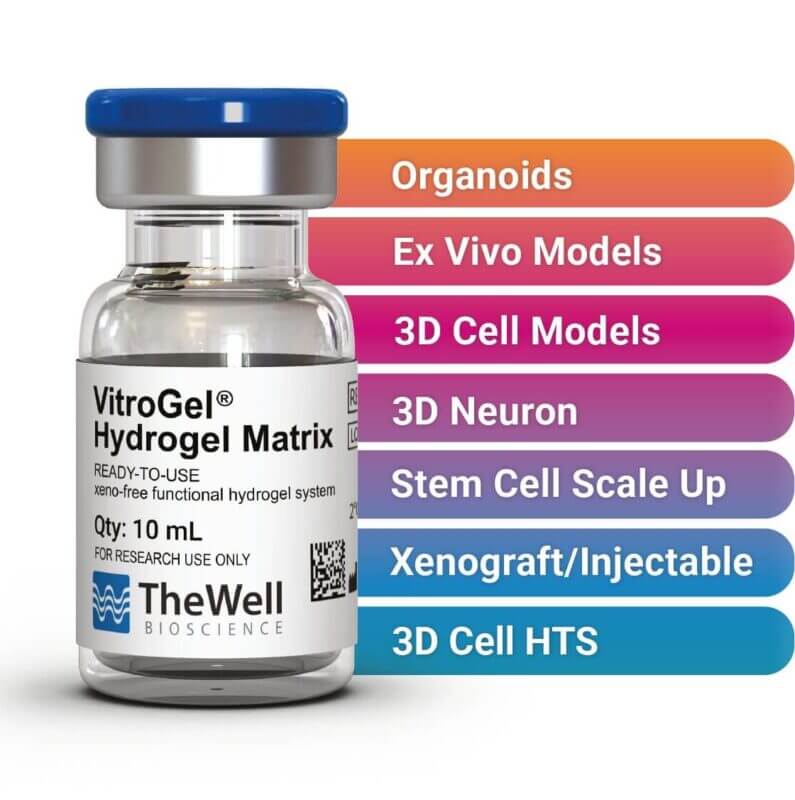
At TheWell Bioscience, our VitroGel® platform aligns with the New Approach Methodologies (NAMs) accepted by the FDA as valid alternatives to animal testing. Designed to support advanced 3D cell culture systems, VitroGel® offers many advantages to bridge the gap between i𝘯 𝘷𝘪𝘵𝘳𝘰 and 𝘪𝘯 𝘷𝘪𝘷𝘰 studies.
Whether you’re working with 2D or 3D cultures, organoids, stem cells, neurons, MSCs, spheroids, functional assays, co-culture systems, or PDX/CDX 𝘪𝘯 𝘷𝘪𝘷𝘰 models—VitroGel® provides a xeno-free, injectable, and room-temperature-stable platform that makes your workflow faster, easier, and more reproducible.
See the full comparison VitroGel® vs animal-based ECM
Xeno-free and Synthetic
100% animal/human origin-free synthetic hydrogel system.

Room Temperature Operation
20-min protocol. Gelation by mixing not temperature dependent.

Biofunctional and Biocompatible
Optimized with multi-functional ligands for many cell types. Biocompatible material suitable for xenograft and in vivo applications.

Reproducible Assays
Batch-to-batch consistency ensures reproducible results. Available for GMP process.

Injectable
Long-term injectability after gelation with no needle clogging. Unique shear-thinning and rapid recovery properties for excellent cell retention.

Ethical
Unlike animal-based ECM, no mice are sacrificed in product manufacturing..
Discover why VitroGel® is the leading animal-free hydrogel.
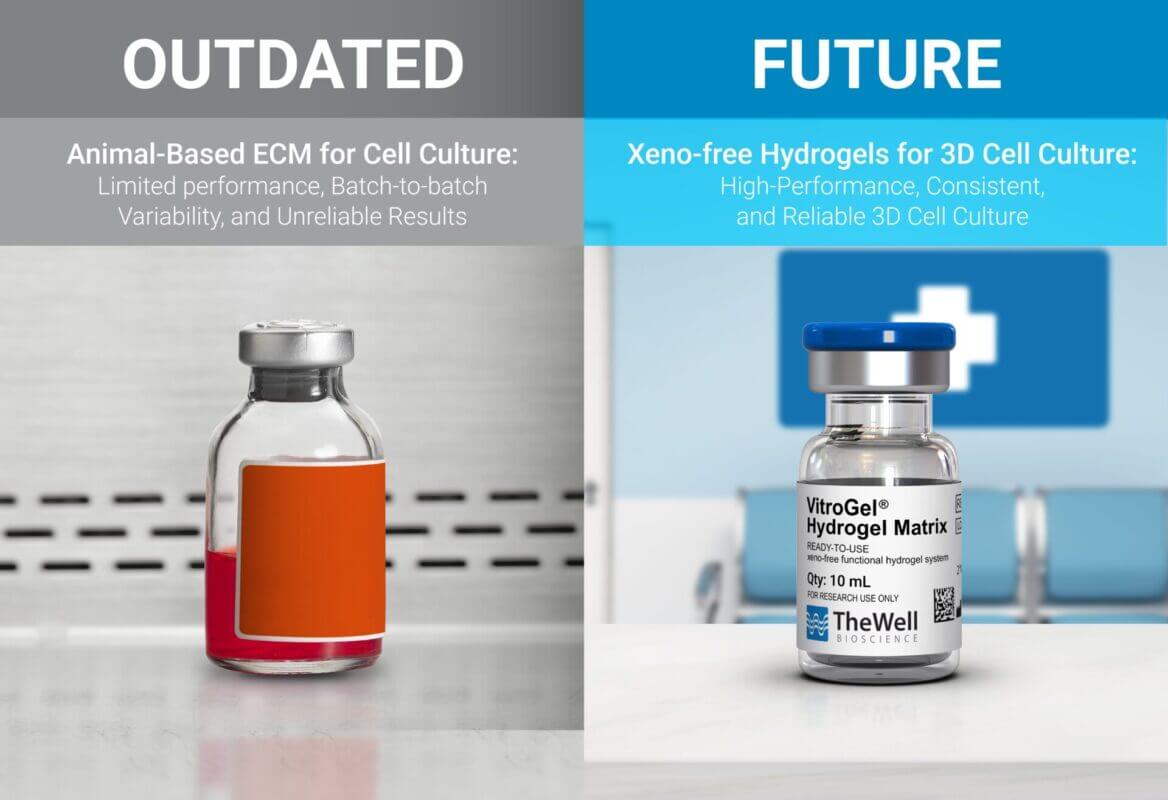
Why Animal-Based ECMs Have No Place in the Future of 3D Cell Models | Blog
Discover why animal-derived extracellular matrices (ECMs) are becoming obsolete for 3D cell modeling due to their limitations in reproducibility, ethical concerns, and incompatibility with automation, while positioning xeno-free synthetic platforms like VitroGel® as scalable, animal-free alternatives.
What is VitroGel® | Overview Video
Learn how VitroGel® can support you in transitioning to an animal-free cell culture research.